Make It Local - an exhbition by second year 3D design students as part of Dulwhich Festival Artist Open House weekends
I exhibited my Street Drawings short film and I put the spirograph outside on the patio for people to pick up. I spirographed a little on the patio by myself, collaboratly with some children (picture below) and others carried on with the spirograph/drew some spirograph inspired patterns to.
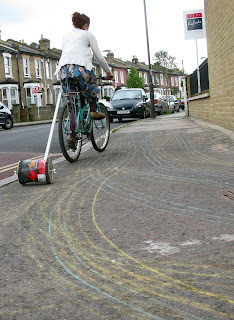
Short film of a few of my street drawings with the bike tools. First site with chalk tied to rake, second and third with the rolling paint tin with holes drilled in to allow coloured sand to trail out.
This year the London Wildlife are showing there Life Cycle Garden at RHS Hampton Court Flower Show. It is a sustainable garden that explores the natural cycles that are essential to successful wildlife and climate friendly gardening. It is a place where everyday objects come to life and all the stages in plant life cycles are celebrate, including death and decay.
The design illustrates chronological cycles of life, and emphasis the fundamental importance of sustainability. It finds new uses for material that have been discarded, reclaiming and recycling them into wildlife and climate friendly habitats.
The garden supports the London Wildlife Trust's Garden for a Living London Campaign, which highlights the importance of the capital's gardens for wildlife and people. In urban areas especially, gardens will help reduce the impacts of climate change.
The Life Cycle garden design by Elaine Hughes
Together with Owen Hodgkinson we will be designing and making a trellis for the garden, to act as sculpture feature physically representing the cycle and decay of the life cycle, a light feature and a plant support.
London Wildlife Trust: www.wild.london.org.uk
Living London Campaigne: www.wild.london.org.uk/gardening
Centre for Wildlife Gardening: 28 Marsden Road, Peckham, London, SE15 4EE
possted by: eventhorizon53, 11 January 2008 "built this harmonograph, in part for the Art Faculty show at the college where I teach photography. I wanted it to be made primarily of wood, so I hollowed out redwood blocks that I filled with lead for the weights."
post comments by eventhorizon53: - The 2 main Pendulums have varying weights and Radi ans swing perpendicular to one another, which creates varying frequencies which are transfered to the pen by arms. The pen rest on paper that is on a table on a third pendulum which rest on a gimble allowning it to rotate adding a third frequency to the resulting Lissajous diagram. The paper is held in place by a small amount of rubber cement on the corners of the table. - Sure, the bearings are sealed roller bearings that I bought on Ebay. 5/8 of an inch diameter and 3/16 hole. The gimble I made by cutting donut out of the table and used a drill press to get the two holes perfectly in line
posted by johnmoriarty, 21 September 2007 "This is a Harmonograph that was made for the teamYES* exhibition; Experiments in the Field of Fun, in Monster Truck Gallery, Dublin."
posted by: K1Models, 12 November 2007 Automatic drawing machine using pendulums. Prototype version for proof of concept
Theo Jansen is a Dutch artist who since 1990 has been building walking kinetic sculptures that he calls a new form of life. His "Strandbeests" walk the coastline of Holland, feeding on wind and fleeing from water.
The initial generations were bulky and rudimentary they have evolved to adapt and react to their environment on the beaches. “Over time, these skeletons have become increasingly better at surviving the elements such as storms and water and eventually I want to put these animals out in herds on the beaches, so they will live their own lives.” Theo’s more sophisticated creations are able to detect once they have entered the water and walk away from it, and one species will even anchor itself to the earth if it senses a storm approaching.
They are intricately constructed of wood, plastic tubes – electrical conduit a purpose design electrical piping systems used for protecting and routing electrical wiring. “I make skeletons that are able to walk on the wind, so they don’t have to eat.” The creatues have stomachs consisting of recycled plastic bottles that store air, captured by gossamer (light, delicate) wings that flap and pump air a high pressure to us in the absence of wind, these to power the many spindly legs.
www.ted.com Theo Jansen: the art of creating creatures March 2007
A harmonograph is a mechanical apparatus that employs pendulums to create a geometric image. The drawings created typically are Lissajous curves, or related drawings of greater complexity. The devices, which began to appear in the mid-19th century and peaked in popularity in the 1890s, cannot be conclusively attributed to a single person, although Hugh Blackburn, a professor of mathematics at the University of Glasgow, is commonly believed to be the official inventor.[1]
A simple, so-called 'lateral' harmonograph uses two pendulums to control the movement of a pen relative to a drawing surface. One pendulum moves the pen back and forth along one axis and the other pendulum moves the drawing surface back and forth along a perpendicular axis. By varying the frequency of the pendulums relative to one another (and phase) different patterns are created. Even a simple harmonograph as described can create ellipses, spirals, figure eights and other Lissajous figures.
More complex harmonographs incorporate three or more pendulums or linked pendulums together (for example hanging one pendulum off another), or involve rotary motion in which one or more pendulums is mounted on gimbals to allow movement in any direction.
I put some red acrylic into tin with three holes drilled I trailed it around for a while in the snow, filmed by Chloe
(I wiped the paint off the roof afterwards - no damage done)
After making a trail, I started to repeatedly go over one area - the same motion as if I was sweeping but having the reverse affect splattering red paint all across the ground.
I then wanted to clear some of that paint which was outside our door to disguise my trail, I placed it in the road in a line down the middle - contrast of the white and red snow against the mulsh, would be interesting to do this down a large section of road
Then I used up the last of the snow in the pot I had used for mixing the paint and used this as a mould.
I started to clean out the tin outside in our garden with water and carried on spreading the red- as, I was doing it I thought it would of been more visually striking, if i filled in the lower part all in red
Amongst many things I am a designer of interactive objects and events. My work explores encouraging a sense of familiarity and ownership of public spaces, through collaboration and interaction between strangers and friends, in the form of playful interventions and acts of doing. Recently I have begun exploring edible gardening. I am also a member of Raw Canvas, an initiative run at Tate Modern by young adults, for young adults, organising events and peer led workshops to make art more accessible to others.


+Elaine+Hughes.jpg)